Feedback by Arnaud Dowkiw
By: Arnaud Dowkiw
The summer school was organized by the Austrian Research Centre for Forests and took place in its Wien headquarters surrounded by the beautiful Vienna Woods.
After a short introduction to Spatial Data manipulation in R, the first day was dedicated to the presentation of Universal Response Functions (URFs) which are mathematical models in ecology and forestry that combine genetic and environmental effects to predict the phenotypic performance of populations (such as tree provenances) across varied climatic conditions and planting sites.
The second day was devoted primarily to presentations on the following topics :
- High throuhput phenotyping under controlled conditions as conducted at the Vienna Bio Centre Phenotypic Facility that we were going to visit the next day
- Pollen-based assisted migration
- Quantitative genetic theory of population adaptation
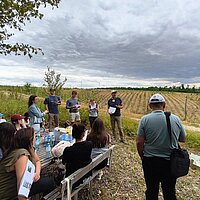
Day 3 was an excursion day that gave us the opportunity to visit the phenotyping facility of the Vienna Bio Center and to see species and provenance trials in real life.
On day 4, all participants were divided into different groups, each of which focused on a specific species, with the final goal being to develop a recommendation of the best provenance to plant at each given location under future climate change.
Group presentations of the results took place in day 5.
Even though the program was very intensive and covered a wide range of topics, I achieved the goal I had set for myself, which was to become more familiar with the concept of assisted migration. I was able to understand not only its main principles but also its limitations. Now I know where to find climate variables for past and future periods and how to use them.
I am very grateful to my colleagues at the BFW and the Vienna Biocenter for organizing this training and all these visits with a genuine desire to share their knowledge. I would like to thank Euforgen for helping to fund my participation.